DAVIE, FL (CBS Miami) – New technology helped Davie police crack a seven-year-old sexual battery cold case.
Hugo Giron-Polanco, 38, was taken into custody Thursday after detectives compared a voluntary DNA sample to one taken from the victim when the attack happened.
Police say she was walking in the west end of Robbins Park when a man jumped out, grabbed her, and pulled her shirt over her head in November 2010. The woman said when she struggled to break free, the man repeatedly punched her in the head as he dragged her down a path. She said she was able to see him holding a screwdriver pointed at her abdomen.
She said at one point he threw her down on the ground and removed her pants, and underwear, and sexually battered her.
At the time there was no DNA hit and Florida’s first “John Doe” warrant was filed.
The DNA was recently submitted to a private company for analysis that provided a sketch based on the sample’s profile. Detectives said that new technology led them to find their suspect.
“That information was given to detectives that canvassed the area. They located this individual that matched the analysis that was given to them. That individual consented to giving his DNA and that DNA came back as a match,” said Det. Mark Leone.
Police say Giron-Polanco is in the U.S. illegally. U.S. Border Patrol has placed him on...
Ninety miles from the South Eastern tip of the United States, Liberty has no stead. In order for Liberty to exist and thrive, Tyranny must be identified, recognized, confronted and extinguished.
infinite scrolling
Monday, January 1, 2018
10 Lifehacks from 100 Years Ago
IMAGE CREDIT:
NEW YORK PUBLIC LIBRARY
By Therese Oneill
In the late 1880s, cigarette manufacturers began inserting stiffening cards into their paper packs of cigarettes to strengthen the containers. It wasn't long before they got the idea to put artwork, trivia, famous people, and pretty girls onto those cards, grouped into collectible series. The cards, which continued into the 1940s, are highly valuable now, with the most expensive (bearing the face of stringent anti-smoking baseball player Honus Wagner) selling for $2.8 million in 2007.
In the 1910s, Gallaher Ltd of Belfast & London and Ogden's Branch of the Imperial Tobacco Co printed "How-To" series, with clever hints for both everyday and emergency situations. From steaming out a splinter to stopping a mad dog, these cigarette cards told you the smart way to handle many of life's problems.
(Please note these cards were published a hundred years ago, when safety was not as popular a pursuit as it is now. For that reason, we can't recommend trying any of these, as brilliant as they may be.)
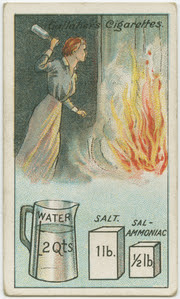
1. HOW TO MAKE A FIRE EXTINGUISHER
"Dissolve one pound of salt and half a pound of sal-ammoniac in two quarts of water and bottle the liquor in thin glass bottles holding about a quart each. Should a fire break out, dash one or more of the bottles into the flames, and any serious outbreak will probably be averted."
2. HOW TO EXTRACT A SPLINTER
"Fill a wide mouthed bottle with hot water nearly to the brim, and press affected part of hand tightly against mouth of bottle. The suction will pull down the flesh, and steam will soon draw out the splinter."
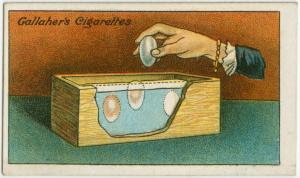
3. HOW TO PRESERVE EGGS
"Eggs for preserving must be newly laid, and by simply putting these into a box or tin of dry salt-burying the eggs right in the salt and keeping it in a cool dry place — it is possible to preserve them for a very long period. No air whatever should be allowed to get to the shell."
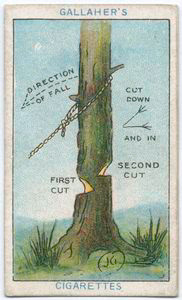
4. HOW TO FELL A TREE
"Having decided which side you wish the tree to fall, cut alternatively a downward and inward cut as shown. When about half through, proceed to cut the other side a few inches higher, and finally pull tree down by means of ropes."
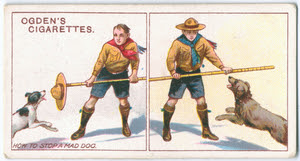
5. HOW TO STOP A MAD DOG
"A scout's staff, a walking-stick, or even a handkerchief or hat may be held before you as shown. The dog invariably endeavours to paw down your defense before biting, thus giving you the opportunity of disabling him by a kick."
6. HOW TO KEEP PLANTS WATERED WHILE AWAY ON HOLIDAY
"Fill a large pail with water, and stand it a little above the level of the plants and group round or near as many plants as practical. Loosely plait two or three strands of wool together, immerse completely in water, and place one end in the pail, weighted, and touching the bottom. Rest the other end on the soil: a separate plait of wool is advisable for each pot."
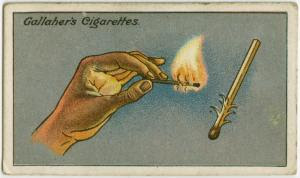
7. HOW TO LIGHT A MATCH IN THE WIND
"The familiar difficulty of lighting a match in a wind can be to a great extent overcome if thin shavings are first cut on the match towards its striking end, as shown in the picture. On lighting the match the curled strips catch fire at once; the flame is stronger and has a better chance."
8. HOW TO MAKE A CHAIR TO CROSS A STREAM
"Fasten a strong rope to a tree and let a boy swim across the stream and fasten the other end to a tree on an opposite bank. Make the chair, fasten it to a running loop or a block pulley, and by means of a light rope fastened to the middle of (the) chair and held by a scout at each end, those unable to swim are safely passed over."
9. HOW TO RESCUE SOMEONE FROM ELECTRIC SHOCK
"In rescuing a person touched by a "live wire" do not attempt to take hold of him if he is still grasping the wire, unless your hands are protected by rubber gloves, a water-proof coat, or several thicknesses of dry cloth. Stand on glass or dry wood, and try and have (the) current switched off, and send at once for a doctor."
10. HOW TO MAKE A WATER FILTER
"A most handy and efficacious filter can be made out of an ordinary perfectly clean zinc water pail, through the bottom of which a hole has been drilled and a small pipe fitted. The water percolates through the layers of fine and coarse sand, and clean picked gravel and stones, with which the pail is filled, filtering through to the bottom in a clear state."
Nanotech Could Make Humans Immortal By 2040, Futurist Says
Computerworld — In 30 or 40 years, we'll have microscopic machines traveling through our bodies, repairing damaged cells and organs, effectively wiping out diseases. The nanotechnology will also be used to back up our memories and personalities.
In an interview with Computerworld , author and futurist Ray Kurzweil said that anyone alive come 2040 or 2050 could be close to immortal. The quickening advance of nanotechnology means that the human condition will shift into more of a collaboration of man and machine , as nanobots flow through human blood streams and eventually even replace biological blood, he added.
That may sound like something out of a sci-fi movie, but Kurzweil, a member of the Inventor's Hall of Fame and a recipient of the National Medal of Technology, says that research well underway today is leading to a time when a combination of nanotechnology and biotechnology will wipe out cancer, Alzheimer's disease , obesity and diabetes .
It'll also be a time when humans will augment their natural cognitive powers and add years to their lives, Kurzweil said.
"It's radical life extension," Kurzweil said . "The full realization of nanobots will basically eliminate biological disease and aging. I think we'll see widespread use in 20 years of [nanotech] devices that perform certain functions for us. In 30 or 40 years, we will overcome disease and aging. The nanobots will scout out organs and cells that need repairs and simply fix them. It will lead to profound extensions of our health and longevity."
Of course, people will still be struck by lightning or hit by a bus, but much more trauma will be repairable. If nanobots swim in, or even replace, biological blood, then wounds could be healed almost instantly. Limbs could be regrown. Backed up memories and personalities could be accessed after a head trauma.
Today, researchers at MIT already are using nanoparticles to deliver killer genes that battle late-stage cancer. The university reported just last month the nano-based treatment killed ovarian cancer, which is considered to be one of the most deadly cancers, in mice.
And earlier this year, scientists at the University of London reported using nanotechnology to blast cancer cells in mice with "tumor busting" genes, giving new hope to patients with inoperable tumors. So far, tests have shown that the new technique leaves healthy cells undamaged.
With this kind of work going on now, Kurzweil says that by 2024 we'll be adding a year to our life expectancy with every year that passes. "The sense of time will be running in and not running out," he added. "Within 15 years, we will reverse this loss of remaining life expectancy. We will be adding more time than is going by."
And in 35 to 40 years, we basically will be immortal, according to the man who wrote The Age of Spiritual Machines and The Singularity is Near: When Humans Transcend Biology .
Kurzweil also maintains that adding microscopic machines to our bodies won't make us any less human than we are today or were 500 years ago.
"The definition of human is that we are the species that goes beyond our limitations and changes who we are," he said. "If that wasn't the case, you and I wouldn't be around because at one point life expectancy was 23. We've extended ourselves in many ways. This is an extension of who we are. Ever since we picked up a stick to reach a higher branch, we've extended who we are through tools. It's the nature of human beings to change who we are."
But that doesn't mean there aren't parts of this future that don't worry him. With nanotechnology so advanced that it can travel through our bodies and affect great change on them, come dangers as well as benefits.
The nanobots, he explained, will be self-replicating and engineers will have to harness and contain that replication.
"You could have some self-replicating nanobot that could create copies of itself... and ultimately, within 90 replications, it could devour the body it's in or all humans if it becomes a non-biological plague," said Kurzweil. "Technology is not a utopia. It's a double-edged sword and always has been since we first had fire."
In an interview with Computerworld , author and futurist Ray Kurzweil said that anyone alive come 2040 or 2050 could be close to immortal. The quickening advance of nanotechnology means that the human condition will shift into more of a collaboration of man and machine , as nanobots flow through human blood streams and eventually even replace biological blood, he added.
That may sound like something out of a sci-fi movie, but Kurzweil, a member of the Inventor's Hall of Fame and a recipient of the National Medal of Technology, says that research well underway today is leading to a time when a combination of nanotechnology and biotechnology will wipe out cancer, Alzheimer's disease , obesity and diabetes .
It'll also be a time when humans will augment their natural cognitive powers and add years to their lives, Kurzweil said.
Of course, people will still be struck by lightning or hit by a bus, but much more trauma will be repairable. If nanobots swim in, or even replace, biological blood, then wounds could be healed almost instantly. Limbs could be regrown. Backed up memories and personalities could be accessed after a head trauma.
Today, researchers at MIT already are using nanoparticles to deliver killer genes that battle late-stage cancer. The university reported just last month the nano-based treatment killed ovarian cancer, which is considered to be one of the most deadly cancers, in mice.
With this kind of work going on now, Kurzweil says that by 2024 we'll be adding a year to our life expectancy with every year that passes. "The sense of time will be running in and not running out," he added. "Within 15 years, we will reverse this loss of remaining life expectancy. We will be adding more time than is going by."
And in 35 to 40 years, we basically will be immortal, according to the man who wrote The Age of Spiritual Machines and The Singularity is Near: When Humans Transcend Biology .
Kurzweil also maintains that adding microscopic machines to our bodies won't make us any less human than we are today or were 500 years ago.
"The definition of human is that we are the species that goes beyond our limitations and changes who we are," he said. "If that wasn't the case, you and I wouldn't be around because at one point life expectancy was 23. We've extended ourselves in many ways. This is an extension of who we are. Ever since we picked up a stick to reach a higher branch, we've extended who we are through tools. It's the nature of human beings to change who we are."
But that doesn't mean there aren't parts of this future that don't worry him. With nanotechnology so advanced that it can travel through our bodies and affect great change on them, come dangers as well as benefits.
The nanobots, he explained, will be self-replicating and engineers will have to harness and contain that replication.
"You could have some self-replicating nanobot that could create copies of itself... and ultimately, within 90 replications, it could devour the body it's in or all humans if it becomes a non-biological plague," said Kurzweil. "Technology is not a utopia. It's a double-edged sword and always has been since we first had fire."
The 90 Miles Mystery Box: Episode #123
You have come across a mystery box. But what is inside?
It could be literally anything from the serene to the horrific,
from the beautiful to the repugnant,
from the mysterious to the familiar.
If you decide to open it, you could be disappointed,
you could be inspired, you could be appalled.
This is not for the faint of heart or the easily offended.
You have been warned.
Sunday, December 31, 2017
5 Ancient New Year’s Celebrations
There’s nothing new about New Year’s. Festivals marking the beginning of the calendar have existed for millennia, and a few are still actively observed by millions of people around the world. Get the facts on the ways 5 ancient civilizations rang in the New Year.These early New Year’s celebrations often had important social, political and religious implications, but in some cultures the holiday traditions were not so different from the champagne, parties and fireworks of today. Get the facts on the ways 5 ancient civilizations rang in the New Year.
1. Babylonian Akitu
Following the first new moon after the vernal equinox in late March, the Babylonians of ancient Mesopotamia would honor the rebirth of the natural world with a multi-day festival called Akitu. This early New Year’s celebration dates back to around 2000 B.C., and is believed to have been deeply intertwined with religion and mythology. During the Akitu, statues of the gods were paraded through the city streets, and rites were enacted to symbolize their victory over the forces of chaos. Through these rituals the Babylonians believed the world was symbolically cleansed and recreated by the gods in preparation for the new year and the return of spring.
One fascinating aspect of the Akitu involved a kind of ritual humiliation endured by the Babylonian king. This peculiar tradition saw the king brought before a statue of the god Marduk, stripped of his royal regalia and forced to swear that he had led the city with honor. A high priest would then slap the monarch and drag him by his ears in the hope of making him cry. If royal tears were shed, it was seen as a sign that Marduk was satisfied and had symbolically extended the king’s rule. Some historians have since argued that these political elements suggest the Akitu was used by the monarchy as a tool for reaffirming the king’s divine power over his people.
The Roman New Year also originally corresponded with the vernal equinox, but years of tampering with the solar calendar eventually saw the holiday established on its more familiar date of January 1. For the Romans, the month of January carried a special significance. Its name was derived from the two-faced deity Janus, the god of change and beginnings. Janus was seen as symbolically looking back at the old and ahead to the new, and this idea became tied to the concept of transition from one year to the next.
Romans would celebrate January 1 by giving offerings to Janus in the hope of gaining good fortune for the new year. This day was seen as setting the stage for the next twelve months, and it was common for friends and neighbors to make a positive start to the year by exchanging well wishes and gifts of figs and honey with one another. According to the poet Ovid, most Romans also chose to work for at least part of New Year’s Day, as idleness was seen as a bad omen for the rest of the year.
3. Ancient Egyptian Wepet Renpet
Ancient Egyptian culture was closely tied to the Nile River, and it appears their New Year corresponded with its annual flood. According the Roman writer Censorinus, the Egyptian New Year was predicted when Sirius—the brightest star in the night sky—first became visible after a 70-day absence. Better known as a heliacal rising, this phenomenon typically occurred in mid-July just before the annual inundation of the Nile River, which helped ensure that farmlands remained fertile for the coming year. Egyptians celebrated this new beginning with a festival known as Wepet Renpet, which means “opening of the year.” The New Year was seen as a time of rebirth and rejuvenation, and it was honored with feasts and special religious rites.
Not unlike many people today, the Egyptians may have also used this as an excuse for getting a bit tipsy. Recent discoveries at the Temple of Mut show that during the reign of Hatshepsut the first month of the year played host to a “Festival of Drunkenness.” This massive party was tied to the myth of Sekhmet, a war goddess who had planned to kill all of humanity until the sun god Ra tricked her into drinking herself unconscious. In honor of mankind’s salvation, the Egyptians would celebrate with music, sex, revelry and—perhaps most important of all—copious amounts of beer.
4. Chinese New Year
One of the oldest traditions still celebrated today is Chinese New Year, which is believed to have originated over 3,000 years ago during the Shang Dynasty. The holiday began as a way of celebrating the new beginnings of the spring planting season, but it later became entangled with myth and legend. According to one popular tale, there was once a bloodthirsty creature called Nian—now the Chinese word for “year”—that preyed on villages every New Year. In order to frighten the hungry beast, the villagers took to decorating their homes with red trimmings, burning bamboo and making loud noises. The ruse worked, and the bright colors and lights associated with scaring off Nian eventually became integrated into the celebration.
Festivities traditionally last 15 days and tend to center on the home and the family. People clean their houses to rid them of bad luck, and some repay old debts as a way of settling the previous year’s affairs. In order to encourage an auspicious start to the year they also decorate their doors with paper scrolls and gather with relatives for a feast. Following the invention of gunpowder in the 10th century, the Chinese were also the first to ring in the New Year with fireworks. Since Chinese New Year is still based on a lunar calendar that dates back to the second millennium BC, the holiday typically falls in late January or early February on the second new moon after the winter solstice. Each year is associated with one of 12 zodiacal animals: the rat, ox, tiger, rabbit, dragon, snake, horse, goat, monkey, rooster, dog and pig.
5. Nowruz
While it is still celebrated in Iran and other parts of the Middle East and Asia, the roots of Nowruz (or “New Day”) reach far back into antiquity. Often called the “Persian New Year,” this 13-day spring festival falls on or around the vernal equinox in March and is believed to have originated in modern day Iran as part of the Zoroastrian religion. Official records of Nowruz did not appear until the 2nd century, but most historians believe its celebration dates back at least as far as the 6th century B.C. and the rule of the Achaemenid Empire. Unlike many other ancient Persian festivals, Nowruz persisted as an important holiday even after Iran’s conquest by Alexander the Great in 333 BC and the rise of Islamic rule in the 7th century A.D.
Ancient observances of Nowruz focused on the rebirth that accompanied the return of spring. Monarchs would use the holiday to host lavish banquets, dispense gifts and hold audiences with their subjects. Other traditions included feasts, exchanging presents with family members and neighbors, lighting bonfires, dyeing eggs and sprinkling water to symbolize creation. One unique ritual that arose around the 10th century involved electing a “Nowruzian Ruler”: a commoner who would pretend to be king for several days before being “dethroned” near the end of the festival. Nowruz has evolved considerably over time, but many of its ancient traditions—particularly the use of bonfires and colored eggs—remain a part of the modern holiday, which is observed by an estimated 300 million people each year.
Did You Know?
- The popular New Year’s song “Auld Lang Syne” is at least 220 years old. The tune was originally penned in 1788 by the Scottish poet Robert Burns, who claimed he had assembled it from a variety of older sources. Despite its long history, “Auld Lang Syne” didn’t become popularly associated with the holiday season until 1929, when Canadian bandleader Guy Lombardo began using it as part of his New Year’s Eve broadcasts.
WikiLeaks Drops Proof That NYTimes Colluded With Hillary Clinton
You thought 2017 was going to end without a bang -- other than the fireworks?
Think again.
After the New York Times on Saturday published a story headlined "Republican Attacks on Mueller and F.B.I. Open New Rift in G.O.P.," WikiLeaks couldn't stand it anymore. In a late-night post on Twitter, WikiLeaks revealed that a Times reporter used to feed State Department email updates of the stories the paper would be publishing DAYS before the stories appeared.
At the time, Hillary Clinton was the Secretary of State.
The heads-up email was intended to give State (and Clinton) time to come up with some spin for stories that may have caused problems. Or, in another possible scenario, the heads up could give the State Department time to create a diversion for the same day, thus overriding a damaging story with other news its friends in the mainstream media would happily cover instead.
The players in the WikiLeaks email are interesting. Scott Shane is the national security reporter for The Times. And the recipient of his email, Philip Crowley, was at the time the United States Assistant Secretary of State for Public Affairs under Clinton’s State Department.
As 2017 comes to an end, its clear the Clinton scandals won't go away any time soon.
On Friday, the Justice Department released thousands of Clinton emails. "Several emails with classified information from former Hillary Clinton aide Huma Abedin were among a tranche of documents released Friday that were found on Anthony Weiner's personal computer during an FBI probe," USA Today reported.
Think again.
After the New York Times on Saturday published a story headlined "Republican Attacks on Mueller and F.B.I. Open New Rift in G.O.P.," WikiLeaks couldn't stand it anymore. In a late-night post on Twitter, WikiLeaks revealed that a Times reporter used to feed State Department email updates of the stories the paper would be publishing DAYS before the stories appeared.
At the time, Hillary Clinton was the Secretary of State.
Email shows New York Times handed over Cablegate's publication schedule to the US government (without telling @WikiLeaks) giving the State Department, then headed by Hillary Clinton, up to 9 days in advance to spin the revelations or create diversions. https://foia.state.gov/searchapp/DOCUMENTS/AugSept2016/F-2012-20462/DOC_0C05572024/C05572024.pdf …
The players in the WikiLeaks email are interesting. Scott Shane is the national security reporter for The Times. And the recipient of his email, Philip Crowley, was at the time the United States Assistant Secretary of State for Public Affairs under Clinton’s State Department.
As 2017 comes to an end, its clear the Clinton scandals won't go away any time soon.
On Friday, the Justice Department released thousands of Clinton emails. "Several emails with classified information from former Hillary Clinton aide Huma Abedin were among a tranche of documents released Friday that were found on Anthony Weiner's personal computer during an FBI probe," USA Today reported.
After the emails were made public, Judicial Watch President Tom Fitton called the release a "major victory."
"Judicial Watch has forced the State Department to finally allow Americans to see these public documents," Fitton said. "That these government docs were on Anthony Weiner’s laptop dramatically illustrates the need for the Justice Department to finally do a serious investigation of Hillary Clinton’s and Huma Abedin’s obvious violations of law."
The FBI said most of the emails ended up on Weiner's computer because of backups from Abedin's personal electronic devices. Former FBI Director James Comey has said investigators could not prove Abedin acted with criminal intent or "had a sense that what she was doing was in violation of the law."
A November 2010 email was partially redacted due to "classified" and "confidential" information. It detailed a planned call between Clinton and Saudi Foreign Minister Prince Saud al-Faisal, where then-Secretary of State Clinton would warn al-Faisal about...
Subscribe to:
Comments (Atom)