 |
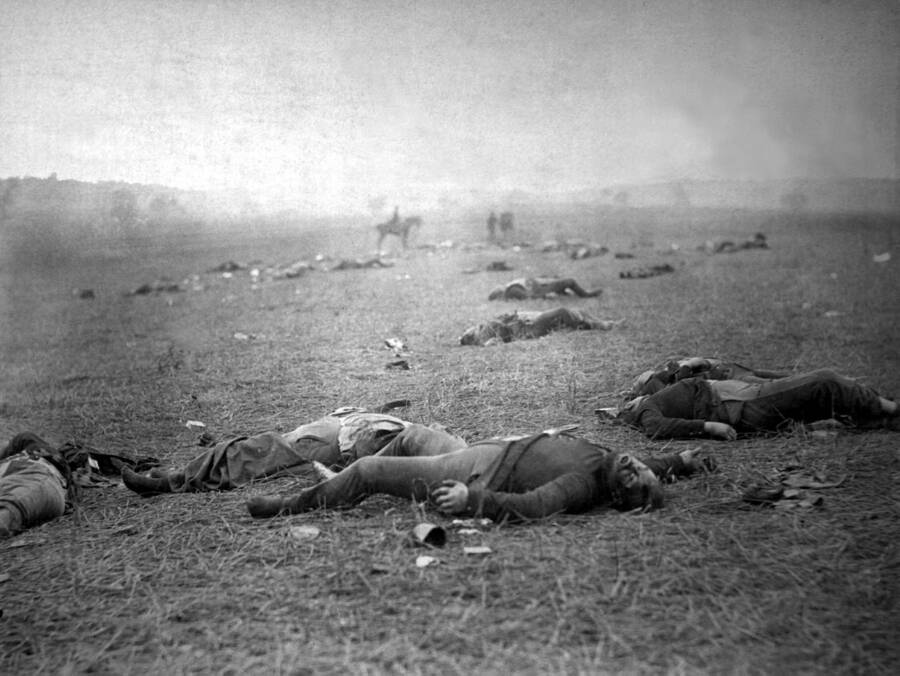
| Union soldiers lie dead after the Battle of Gettysburg. Circa July 4 – July 7, 1863. |
The Battle of Gettysburg begins in Gettysburg, Pennsylvania. The battle, which endured until July 3, resulted in approximately 23,000 Union and 28,000 Confederate casualties. It was a resounding victory for the Union and a turning point in the American Civil War, which ended in April 1865.
Overview of the Battle of Gettysburg
The Battle of Gettysburg was a pivotal engagement in the American Civil War, fought from July 1 to July 3, 1863. It is widely regarded as a turning point in the conflict, marking a significant victory for the Union forces.
Key Facts
| Attribute | Details |
|---|---|
| Location | Gettysburg, Pennsylvania |
| Dates | July 1–3, 1863 |
| Union Commander | Major General George G. Meade |
| Confederate Commander | General Robert E. Lee |
| Union Strength | Approximately 93,500 to 104,256 soldiers |
| Confederate Strength | Approximately 65,000 to 75,000 soldiers |
| Casualties | Over 50,000 combined (23,000 Union, 28,000 Confederate) |
Significance of the Battle
- Turning Point: The Union victory at Gettysburg halted Lee's invasion of the North, preventing further Confederate advances into Union territory.
Impact on Morale: The battle boosted Northern morale and diminished the hopes of the Confederacy for recognition from European powers.
Military Consequences: The defeat forced Lee to fight defensively for the remainder of the war, significantly altering the course of the conflict.
Aftermath
The Battle of Gettysburg resulted in staggering casualties, making it the bloodiest battle of the Civil War. The Union's success here set the stage for future victories and ultimately contributed to the preservation of the United States.
Confederate and Union soldiers shake hands across the wall at the 1938 reunion for the Veterans of the Battle of Gettysburg
An amputation is performed in a hospital tent at Gettysburg (1863)
More This Day In History:
May 4, 1905: Construction Begins On The Panama Canal
May 5, 1818: Karl Marx Is Born
May 10, 1869: The Transcontinental Railroad Is Completed
May 5, 1818: Karl Marx Is Born
May 10, 1869: The Transcontinental Railroad Is Completed
May 21, 1927: Charles Lindbergh Completes His Transatlantic Flight
This Day In History: May 23, 1934: Bonnie And Clyde Are Killed
This Day In History: May 23, 1934: Bonnie And Clyde Are Killed
May 26, 1896: Nicholas II Is Crowned Czar Of Russia
This Day In History - May 30, 1431: Joan Of Arc Is Burned At The Stake
June 4, 1989: Do You Remember The Tiananmen Square Massacre?
June 8, 1967 - The USS Liberty was attacked by Israeli Air Force jet fighters and Navy torpedo boats in international watersJune 15, 1215: King John Signs The Magna Carta
June 19, 1953: Julius And Ethel Rosenberg Are Executed For Espionage
June 21, 1788: The U.S. Constitution Is Ratified
June 22, 1633: Galileo Galilei Is Forced To Recant His Support Of The Copernican Theory
June 25, 1950: The Korean War Begins
June 26, 1948, the United States launched the Berlin Airlift, known as "Operation Vittles"This Day In History - May 30, 1431: Joan Of Arc Is Burned At The Stake
June 4, 1989: Do You Remember The Tiananmen Square Massacre?
June 8, 1967 - The USS Liberty was attacked by Israeli Air Force jet fighters and Navy torpedo boats in international watersJune 15, 1215: King John Signs The Magna Carta
June 19, 1953: Julius And Ethel Rosenberg Are Executed For Espionage
June 21, 1788: The U.S. Constitution Is Ratified
June 22, 1633: Galileo Galilei Is Forced To Recant His Support Of The Copernican Theory
June 25, 1950: The Korean War Begins
June 28, 1914: Archduke Franz Ferdinand Is Assassinated
June 30, 1908 The Tunguska explosion (or Tunguska event)
No comments:
Post a Comment